St. Junipero Serra

Facts
Patron: of Vocations
Birth: 1713
Death: 1784
Beatified: Pope John Paul II
Canonized: September 23, 2015, Basilica of the National Shrine of the Immaculate Conception, Washington, D.C., by Pope Francis
Author and Publisher - Catholic Online
Printable Catholic Saints PDFs
Shop St. Junipero Serra

Learn More about the Missions St. Junípero Serra Helped Build with California Missions Adventure
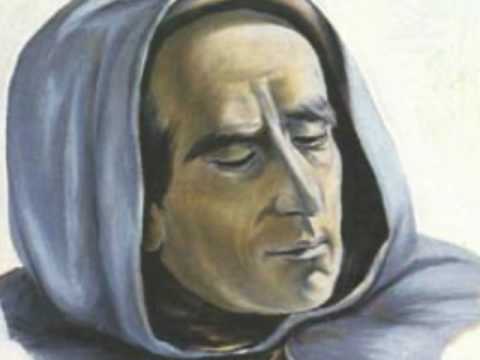
Junípero Serra, originally named Miguel José, was born on November 24, 1713, in Petra, Majorca, Spain. His parents, Antonio Nadal Serra and Margarita Rosa Ferrer, were farmers. Baptized at St. Peter's Church in Petra on the same day, Junípero would go on to become a renowned figure in the history of California.
In his early years, Serra attended the primary school run by the Franciscans in Petra. At the age of 15, his parents entrusted him to a cathedral canon in Palma, where he began attending philosophy classes at the Franciscan monastery of San Francisco.
Serra took his first step toward religious life when he became a novice at the Convento de Jesús near Palma on September 14, 1730. A year later, on September 15, he made his profession and chose the name Junípero in honor of St. Francis' companion. Serra pursued his studies in philosophy and theology at the Convento de San Francisco. The exact date of his ordination to the priesthood remains unknown, but it is believed to have occurred in December 1738. In 1742, he earned his doctorate in theology from the Lullian University in Palma. Shortly after, in January 1749, he was appointed the primary professor of theology at the university and was called to serve as an Indian missionary in America.
Accompanied by Francisco Palóu, Serra set sail for America on April 13, 1749. They arrived in Vera Cruz, Mexico, on December 7, 1749. Instead of using the provided horses, Serra chose to walk the 250 miles from Vera Cruz to Mexico City. On January 1, 1750, they reached San Fernando College, having spent the previous night at the Shrine of Our Lady of Guadalupe.
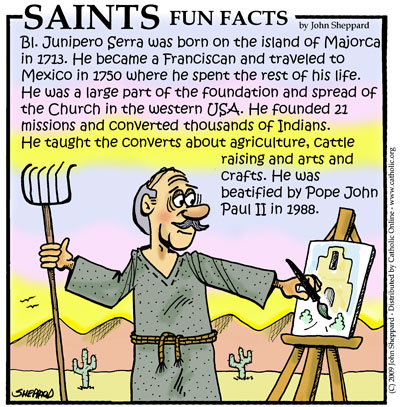
Within six months, Serra responded to an urgent call for volunteers for the Sierra Gorda missions. He joined the mission and spent his time between 1750 and 1758 overseeing the construction of a church, promoting religious and economic development, and learning the Otomí language to effectively teach the Pame Indians. Serra's leadership led to the building of mission churches in the other four towns as well.
Afterward, Serra was assigned to the college of San Fernando, where he held various positions, including choir director, master of novices, college counselor, and confessor. He also preached missions as a home missionary in different cities in Mexico. In 1767, he was appointed the president of the ex-Jesuit missions of Baja California.
Serra's enthusiasm and dedication to spreading the faith led him to volunteer for expeditions to Upper California in 1768. He embarked on the journey and reached Loreto on April 1, where he oversaw the establishment of 15 missions, from San José del Cabo to Santa María. Serra's efforts continued as he founded nine missions in Upper California, including San Diego, San Carlos, San Antonio, San Gabriel, San Luis Obispo, San Francisco, San Juan Capistrano, Santa Clara, and San Buenaventura. He also participated in the founding of Presidio Santa Barbara.
Throughout his missionary work, Serra faced health challenges, including leg and foot issues, which required him to be carried on a stretcher during certain parts of his journey. Despite his physical afflictions, he dedicated the next 15 years of his life to evangelizing in Upper California.
Serra passed away on August 28, 1784, at Mission San Carlos, where he was buried in the church he had constructed. By the end of 1784, the number of baptized Indians at the first nine missions had reached 6,736, with 4,646 Christianized Indians residing in them.
Junípero Serra was known for his zeal, optimism, and devotion to his converts. He fought for the freedom of the Church against royal interference and played a significant role in the establishment and expansion of missions in California. His beatification process began in 1934 and concluded in 1949. He was beatified by Pope John Paul II on September 25, 1988, and later canonized by Pope Francis on September 23, 2015. Junípero Serra is widely recognized as the Apostle of California, with numerous monuments and memorials commemorating his legacy along the Camino Real.
Come Grow With Us
Sign up and walk the Catholic journey with millions around the world.
Receive inspiring emails on saints, daily readings, and free faith-building resources—no cost, ever.
URGENT: Catholic Online School needs your help NOW.
- 7 Morning Prayers
- Mysteries of the Rosary
- Litany of the Bl. Virgin Mary
- Popular Saints
- Popular Prayers
- Female Saints
- Saint Feast Days by Month
- Stations of the Cross
- St. Francis of Assisi
- St. Michael the Archangel
- The Apostles' Creed
- Unfailing Prayer to St. Anthony
- Pray the Rosary







Copyright 2026 Catholic Online. All materials contained on this site, whether written, audible or visual are the exclusive property of Catholic Online and are protected under U.S. and International copyright laws, © Copyright 2026 Catholic Online. Any unauthorized use, without prior written consent of Catholic Online is strictly forbidden and prohibited.
Catholic Online is a Project of Your Catholic Voice Foundation, a Not-for-Profit Corporation. Your Catholic Voice Foundation has been granted a recognition of tax exemption under Section 501(c)(3) of the Internal Revenue Code. Federal Tax Identification Number: 81-0596847. Your gift is tax-deductible as allowed by law.
