St. Willibrord
Facts
Patron: of convulsions; epilepsy; epileptics; Luxembourg; Netherlands; archdiocese of Utrecht, Netherlands
Birth: 658
Death: 739
Author and Publisher - Catholic Online
Printable Catholic Saints PDFs
Shop St. Willibrord
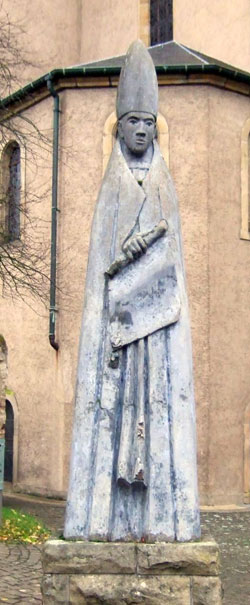
Apostle of the Frisians, missionary bishop, and founder of Echternach. St. Willibrord was born in Northumbria around 658. As a young man he entered the monastery of Ripon under St. Wilfrid, and later traveled to Ireland, where he spent twelve formative years at Rath Melsigi, an important Anglo-Saxon monastic settlement, located in what is now the townland of Clonmelsh, County Carlow. There he trained under Sts. Egbert and Wigbert and received a thorough spiritual and missionary education.
Around 690, Willibrord set out with twelve companions to evangelize the Frisians in what is now the Netherlands. Wishing to ground his work in ecclesial authority, he journeyed to Rome, where Pope Sergius I approved his mission. On a second visit in 695, the pope consecrated him archbishop to the Frisians, establishing his see at Utrecht.
Willibrord carried out his mission with strong support from the Frankish leader Pepin of Heristal, whose patronage gave him access and protection throughout the region. In 698, Willibrord founded the great monastery of Echternach (in present-day Luxembourg), which became the center of his missionary operations and a major cultural and spiritual hub.
His ministry extended beyond Frisia, reaching into Denmark and northern Germany, and he often faced violent opposition from pagan groups. One well-known episode describes an attempt on his life after he destroyed a pagan idol.
The mission suffered a major setback after Pepin’s death in 714, when King Radbod of Frisia reclaimed lost territories and drove out Christian missionaries. Many of Willibrord’s gains were temporarily undone. After Radbod’s death in 719, Willibrord resumed his work with renewed vigor, assisted by St. Boniface, who regarded him as a mentor.
St. Willibrord spent his final years at Echternach, where he died on November 7, 739. He is honored throughout the Low Countries and Luxembourg as the "Apostle of the Frisians."

Come Grow With Us
Sign up and walk the Catholic journey with millions around the world.
Receive inspiring emails on saints, daily readings, and free faith-building resources—no cost, ever.
Sister Sara Has One Message for Every Catholic Family This June
- Easter / Lent
- 5 Lenten Prayers
- Ash Wednesday
- 7 Morning Prayers
- Mysteries of the Rosary
- Litany of the Bl. Virgin Mary
- Popular Saints
- Popular Prayers
- Female Saints
- Saint Feast Days by Month
- Stations of the Cross
- St. Francis of Assisi
- St. Michael the Archangel
- The Apostles' Creed
- Unfailing Prayer to St. Anthony
- Pray the Rosary







Copyright 2026 Catholic Online. All materials contained on this site, whether written, audible or visual are the exclusive property of Catholic Online and are protected under U.S. and International copyright laws, © Copyright 2026 Catholic Online. Any unauthorized use, without prior written consent of Catholic Online is strictly forbidden and prohibited.
Catholic Online is a Project of Your Catholic Voice Foundation, a Not-for-Profit Corporation. Your Catholic Voice Foundation has been granted a recognition of tax exemption under Section 501(c)(3) of the Internal Revenue Code. Federal Tax Identification Number: 81-0596847. Your gift is tax-deductible as allowed by law.