St. Barbara

Facts
Patron: of armourers, artillerymen, architects, mathematicians, miners
Birth: Mid-third Century
Death: Late-third Century
Author and Publisher - Catholic Online
Printable PDF of St. Barbara
Shop St. Barbara

Saint Barbara, also known as the Great Martyr Barbara, was an early Christian Greek martyr born mid-third century in Heliopolis, Phoenicia.
Barbara was the daughter to a rich pagan named Dioscorus. After the death of Barbara's mother, Dioscorus dedicated his life to his only daughter.
Barbara was known for being extremely beautiful. As a way of "protecting" her, Dioscorus shielded her from the world by locker her high up within a tower. He allowed only her pagan teachers to see her.
Barbara spent her days gazing upon the hills and admiring all of God's creations. She often pondered about the "First Cause and Creator of so harmonious and splendid a world." She soon realized the idols her father and teachers worshiped were not of God's creation.
Barbara secretly became a Christian and dedicated her life to knowing the true God and making Him known to others. She offered herself completely to the Lord, choosing a life of consecrated virginity.
As Barbara grew older, her father, Dioscorus began presenting men to her for marriage. She refused them all and warned her father that his persistence could forever damage their relationship.
Dioscorus allowed for Barbara to leave her tower, hoping some freedom would change her attitude. Barbara used this opportunity to meet other Christians. They taught her about the Lord Jesus, the Holy Trinity and the Church. A priest from Alexandria, disguised as a merchant, baptized Barbara into Christ and His Church.
While Barbara was out exploring the world, her father had a private bath-house built for her. The original architectural plans were for two windows to be built, but, while her father was away, Barbara advised the workers to make a third window ? creating a Trinity of light.
Barbara's bathhouse became a place full of healing power and many miracles occurred there. St. Simeon Metaphrastes even compared it to the stream of Jordan.
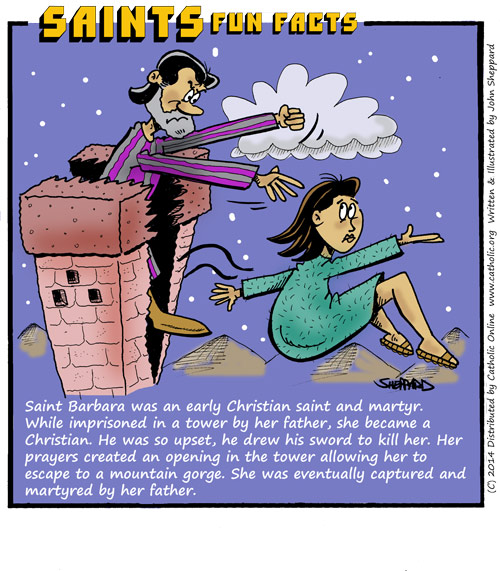
After Dioscorus returned, Barbara informed him she had become a Christian and would no longer worship his idols. Full of rage, her father grabbed his sword and went to strike her. Before he could do so, Barbara ran off.
Her father chased after her, but was abruptly stopped when a hill blocked his way. The hill opened and hid Barbara within a crevice. Dioscorus searched and searched for his daughter, but could not find her.
Dioscorus came across two shepherds and asked them if they had seen her. The first denied, but the second betrayed Barbara. Some legends indicate that he was turned to stone and his flock was turned into locusts.
Her father Dioscorus beat his daughter, locked her up and starved her. He then handed her over to Martianus, the prefect of the city. Together, they continued to beat and torture her, but Barbara never renounced her Christian faith. She prayed to Jesus and he appeared to heal her wounds. This only made Martianus try harder to get her to renounce the Lord and her Christian faith. She refused and her Lord gave her strength to stand firm.
Barbara, along with another virtuous Christian woman named Juliana, were injured with rakes and hooks and led naked throughout the city.
After Barbara prayed, an angel came and covered the pair with a robe and torches used to burn Barbara went out when they came near her.
Finally, Barbara was condemned to death by beheading by her father. Her martyrdom took place on December 4th.
Seen as a punishment for their actions, Dioscorus and Martianus were both killed after being struck by lightning.
In the 6th century relics of St. Barbara were taken to Constantinople. Six hundred years later, they were taken to Kiev by the daughter of the Byzantine Emperor Alexius Comnenos. Today, they rest at the St. Vladimir cathedral in Kiev.
Doubt and questions surrounding the history of St. Barbara caused her to be removed from the General Roman Calendar, but not from the Catholic Church's list of saints.
The United States Army Field Artillery Association and the United States Army Air Defense Artillery Association hold the Order of Saint Barbara as an honorary society within the military.
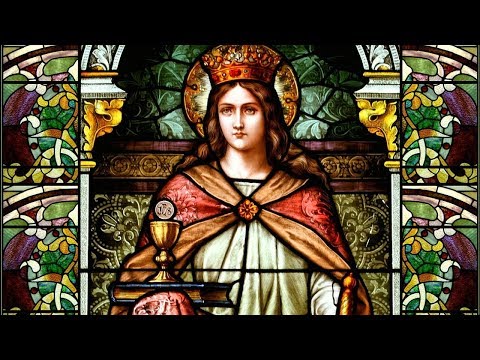
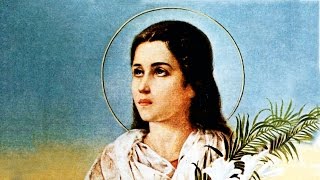
St. Barbara is depicted with mini chains, standing by or holding a tower with three windows, carrying a palm branch, and sometimes with cannons.
She is the patron saint of armourers, artillerymen, architects, mathematicians, miners and the Italian Navy. St. Barbara is one of the Fourteen Holy Helpers, venerated because their intercession is believed to be particularly effective against diseases. Barbara is often invoked against lightning and fire, with associations of explosions. Her feast day is celebrated on December 4.

Come Grow With Us
Sign up and walk the Catholic journey with millions around the world.
Receive inspiring emails on saints, daily readings, and free faith-building resources—no cost, ever.
Sister Sara just dropped the truth about the future of Catholic education… and It’s Not What You Think
- Easter / Lent
- 5 Lenten Prayers
- Ash Wednesday
- 7 Morning Prayers
- Mysteries of the Rosary
- Litany of the Bl. Virgin Mary
- Popular Saints
- Popular Prayers
- Female Saints
- Saint Feast Days by Month
- Stations of the Cross
- St. Francis of Assisi
- St. Michael the Archangel
- The Apostles' Creed
- Unfailing Prayer to St. Anthony
- Pray the Rosary







Copyright 2026 Catholic Online. All materials contained on this site, whether written, audible or visual are the exclusive property of Catholic Online and are protected under U.S. and International copyright laws, © Copyright 2026 Catholic Online. Any unauthorized use, without prior written consent of Catholic Online is strictly forbidden and prohibited.
Catholic Online is a Project of Your Catholic Voice Foundation, a Not-for-Profit Corporation. Your Catholic Voice Foundation has been granted a recognition of tax exemption under Section 501(c)(3) of the Internal Revenue Code. Federal Tax Identification Number: 81-0596847. Your gift is tax-deductible as allowed by law.