Easter Sunday
Easter Sunday - April 5th, 2026
Holy Day of ObligationEaster is the celebration of Christ's resurrection from the dead. It is celebrated on Sunday, and marks the end of Holy Week, the end of Lent, the last day of the Easter Triduum (Holy Thursday, Good Friday and Easter Sunday), and is the beginning of the Easter season of the liturgical year.
As we know from the Gospels, Jesus Christ rose from the dead on the third day following his crucifixion, which would be Sunday. His resurrection marks the triumph of good over evil, sin and death. It is the singular event which proves that those who trust in God and accept Christ will be raised from the dead.
Since Easter represents the fulfillment of God's promises to mankind, it is the most important holiday on the Christian calendar.
In the Gospels, the precise details of the Easter narrative vary slightly, but none of these variances are critical to the main story. In fact, it is argued that the variances are simply matters of style and not substance. Despite the variances, the key aspects of the Easter story all match. Above all, they agree that the tomb of Christ was indeed empty, which is the most essential fact.
Based on direct evidence from the mid-second century, it is believed that Easter was regularly celebrated from the earliest days of the Church.
 The Easter date is movable and always falls on a Sunday between March 22 and April 25. Easter in the Roman Catholic Church is always on the first Sunday after the first full moon after the spring equinox.
Most Catholics attend Easter Vigil at midnight, although the services can be lengthy because many sacraments are performed, such as baptisms and Rite of Christian Initiation for Adults, during the Mass. Services during the daytime on Easter are shorter and well attended.
Sunrise services are common, but are distinctly Protestant. Sunrise services are gathered before dawn and reflect the arrival of the women at Jesus' tomb early in the morning. The services take place outdoors, often in church yards, cemeteries, or in parks, and are timed so the sun will rise during the course of worship.
Traditional family activities vary by region. In the United States, children often hunt for Easter eggs, which are often brightly-dyed hard boiled eggs, though they can be plastic eggs filled with candy or small denominations of money. Candy is a traditional gift for Easter as children often break their Lenten fasts with sweets. Adults tend to share bouquets of flowers, greeting cards, and may gather for a family meal. Such celebrations are often secularized and focused on children and family rather than the religious aspect of the holy day.
Following Easter Sunday, the season of Easter begins and lasts for seven weeks, ending with Pentecost.
On this greatest day of the year, all fasting and somber thoughts
are banished. As St. John Chrysostom announces in this famous
Easter sermon, all are invited to the feast: "Let all then enter
the joy of Our Lord!
Both the first and the last, and those who come after, enjoy your reward!
Rich and poor, dance with one another, sober and slothful,
celebrate the day.
Those who have kept the fast and those who have not, rejoice today, for the table is richly spread.
Fare royally upon it-the calf is a fatted one.
Let no one go away hungry.
All of you, enjoy the banquet of faith!
All enjoy the riches of His goodness.
Let no one cry over his poverty, for the universal Kingdom has
appeared!
Let no one mourn that he has fallen again and again, for
forgiveness has risen from the grave.
Let none fear death, for the death of our Savior has set us free.
He has destroyed it by enduring it.
He spoiled the power of hell when he descended thereto.
Isaiah foretold this when he cried, 'Death has been frustrated in meeting him below!'
It is frustrated, for it is destroyed.
It is frustrated, for it is annihilated.
It is frustrated, for now it is made captive.
For it grabbed a body and discovered God.
It took earth and behold! It encountered Heaven.
It took what was visible, and was overcome by what was invisible.
O Death, where is your sting?
O Death, where is your victory?
Christ is risen, and the demons are cast down.
Christ is risen, and life is set free.
Christ is risen, and the tomb is emptied of the dead.
For Christ, having risen from the dead, is become the first-fruits for those who sleep.
to Him be glory and power forever and ever!
Amen. Alleluia! Alleluia! Alleluia!"
The Feast
Easter is the principal feast of the ecclesiastical year. Leo I (Sermo xlvii in Exodum) calls it the greatest feast ( festum festorum ), and says that Christmas is celebrated only in preparation for Easter. It is the centre of the greater part of the ecclesiastical year. The order of Sundays from Septuagesima to the last Sunday after Pentecost, the feast of the Ascension, Pentecost, Corpus Christi, and all other movable feasts, from that of the Prayer of Jesus in the Garden (Tuesday after Septuagesima ) to the feast of the Sacred Heart (Friday after the octave of Corpus Christi ), depend upon the Easter date.
Commemorating the slaying of the true Lamb of God and the Resurrection of Christ, the corner-stone upon which faith is built, it is also the oldest feast of the Christian Church, as old as Christianity, the connecting link between the Old and New Testaments. That the Apostolic Fathers do not mention it and that we first hear of it principally through the controversy of the Quartodecimans are purely accidental. The connection between the Jewish Passover and the Christian feast of Easter is real and ideal. Real, since Christ died on the first Jewish Easter Day; ideal, like the relation between type and reality, because Christ's death and Resurrection had its figures and types in the Old Law, particularly in the paschal lamb, which was eaten towards evening of the 14th of Nisan.
In fact, the Jewish feast was taken over into the Christian Easter celebration; the liturgy ( Exsultet ) sings of the passing of Israel through the Red Sea, the paschal lamb, the column of fire, etc. Apart, however, from the Jewish feast, the Christians would have celebrated the anniversary of the death and the Resurrection of Christ. But for such a feast it was necessary to know the exact calendar date of Christ's death. To know this day was very simple for the Jews ; it was the day after the 14th of the first month, the 15th of Nisan of their calendar. But in other countries of the vast Roman Empire there were other systems of chronology.
The Romans from 45 B.C. had used the reformed Julian calendar; there were also the Egyptian and the Syro-Macedonian calendar. The foundation of the Jewish calendar was the lunar year of 354 days, whilst the other systems depended on the solar year. In consequence the first days of the Jewish months and years did not coincide with any fixed days of the Roman solar year. Every fourth year of the Jewish system had an intercalary month. Since this month was inserted, not according to some scientific method or some definite rule, but arbitrarily, by command of the Sanhedrin, a distant Jewish date can never with certainty be transposed into the corresponding Julian or Gregorian date (Ideler, Chronologie, I, 570 sq.). The connection between the Jewish and the Christian Pasch explains the movable character of this feast.

Easter has no fixed date, like Christmas, because the 15th of Nisan of the Semitic calendar was shifting from date to date on the Julian calendar. Since Christ, the true Paschal Lamb, had been slain on the very day when the Jews, in celebration of their Passover, immolated the figurative lamb, the Jewish Christians in the Orient followed the Jewish method, and commemorated the death of Christ on the 15th of Nisan and His Resurrection on the 17th of Nisan, no matter on what day of the week they fell. For this observance they claimed the authority of St. John and St. Philip.
In the rest of the empire another consideration predominated. Every Sunday of the year was a commemoration of the Resurrection of Christ , which had occurred on a Sunday. Because the Sunday after 14 Nisan was the historical day of the Resurrection, at Rome this Sunday became the Christian feast of Easter. Easter was celebrated in Rome and Alexandria on the first Sunday after the first full moon after the spring equinox, and the Roman Church claimed for this observance the authority of Sts. Peter and Paul. The spring equinox in Rome fell on 25 March; in Alexandria on 21 March. At Antioch Easter was kept on the Sunday after the Jewish Passover.
In Gaul a number of bishops, wishing to escape the difficulties of the paschal computation, seem to have assigned Easter to a fixed date of the Roman calendar, celebrating the death of Christ on 25 March, His Resurrection on 27 March (Marinus Dumiensis in P.L., LXXII, 47-51), since already in the third century 25 March was considered the day of the Crucifixion (Computus Pseudocyprianus, ed. Lersch, Chronologie, II, 61). This practice was of short duration. Many calendars in the Middle Ages contain these same dates (25 March, 27 March) for purely historical, not liturgical, reasons (Grotenfend, Zeitrechnung, II, 46, 60, 72, 106, 110, etc.). The Montanists in Asia Minor kept Easter on the Sunday after 6 April (Schmid, Osterfestberechnung in der abendlandischen Kirche).
The First Council of Nicaea (325) decreed that the Roman practice should be observed throughout the Church. But even at Rome the Easter term was changed repeatedly. Those who continued to keep Easter with the Jews were called Quartodecimans (14 Nisan) and were excluded from the Church. The computus paschalis , the method of determining the date of Easter and the dependent feasts, was of old considered so important that Durandus (Rit. div. off., 8, c.i.) declares a priest unworthy of the name who does not know the computus paschalis . The movable character of Easter (22 March to 25 April) gives rise to inconveniences, especially in modern times. For decades scientists and other people have worked in vain for a simplification of the computus, assigning Easter to the first Sunday in April or to the Sunday nearest the 7th of April. Some even wish to put every Sunday to a certain date of the month, e.g. beginning with New Year's always on a Sunday, etc. [See L. G?nther, "Zeitschrift Weltall" (1903); Sandhage and P. Dueren in "Pastor bonus" (Trier, 1906); C. Tondini, "L'Italia e la questione del Calendario" (Florence, 1905).]

Learn more about Easter
- Learn More about Easter in the Catholic Encyclopedia
- Be Transformed by Easter
Printable PDF of Easter Sunday
More Lent & Easter
Sister Sara Has One Message for Every Catholic Family This June
Easter 2026 / Lent 2026
Begins on Wednesday February 18th, 2026
Ends on Thursday April 2nd, 2026
'So it is written that the Christ would suffer and on the third day rise from the dead'
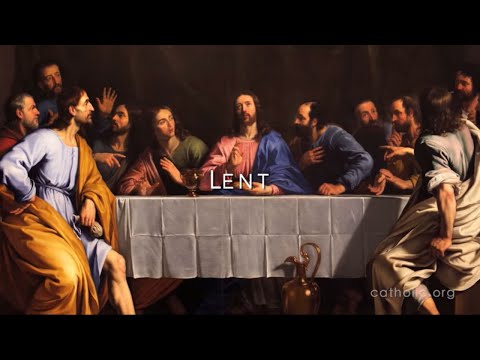

Lent Event
Importance
Stations of the Cross
Every Friday
 Stations of the Cross refers to the depiction of the final hours (or Passion) of Jesus, and the devotion commemorating the Passion... continue reading
Living Lent
February 18th, 2026 - April 2nd, 2026
 Commit to your faith and choose to 'live' Lent. Join our 40-day challenge to authentically live the Lenten season. Get inspired, don't just observe Lent, live it!... continue reading
Mardi Gras / Fat Tuesday
February 17th, 2026
 In France, the people feasted on foods that would be given up during the forty days of Lent. Meats, eggs, and milk were finished off in one day, giving the holiday its French title of 'Mardi Gras' which means Fat Tuesday... continue reading
Ash Wednesday
February 18th, 2026
 Ash Wednesday marks the beginning of the Season of Lent. It takes place 46 days before Easter Sunday. It is a season of penance, reflection, and fasting... continue reading
Palm Sunday
March 29th, 2026
 Palm Sunday, the Sunday before Easter, commemorates Jesus' triumphal entry into Jerusalem, an event mentioned in all four canonical Gospels... continue reading
Holy Week
March 29th, 2026 – April 4th, 2026
 On Palm Sunday, we celebrate the first joy of the season, as we celebrate Our Lord's triumphant entrance into Jerusalem where he was welcomed by... continue reading
Holy Thursday / Last Supper
April 2nd, 2026
 Holy Thursday is the most complex and profound of all religious observances. It celebrates his last supper with the disciples, a celebration of Passover... continue reading
Good Friday
April 3rd, 2026
 On Good Friday, each member of the Church tries to understand at what cost Christ has won our redemption. In the solemn ceremonies of Holy Week... continue reading
Easter Sunday
April 5th, 2026
 Easter is the principal feast of the ecclesiastical year. Leo I calls it the greatest feast, and says that Christmas is celebrated only in preparation for Easter... continue reading
FREE Online Lent / Easter Classes Enroll Now
Ascension of Our Lord
Thursday May 14th, 2026
 The Ascension of Our Lord, a Holy Day of Obligation, celebrates the day that Christ, in the presence of His apostles, ascended bodily into Heaven. The Ascension occurred on the 40th day of Easter, a Thursday... continue reading
Pentecost
Sunday May 24th, 2026
 Pentecost Sunday is one of the most ancient feasts of the Church, celebrated early enough to be mentioned in the Acts of the Apostles (20:16) and Corinthians (16:8)... continue reading
Fasting and Abstinence
Every Friday
 For most people the easiest practice to consistently fulfill will be the traditional one, to abstain from meat on all Fridays of the year. During Lent abstinence from meat on Fridays is obligatory in the... continue reading
What did you give up for Lent?
All of Lent
 From the humorous to the bizarre, people have had interesting Lenten experiences. Tell us about what you are going to give up for this Lenten Year... continue reading
 Everything answered from when does lent end, ashes, giving something up, stations of the cross and blessed palms. The key to understanding the meaning of Lent is simple... continue reading
The Resurrection of Jesus is the crowning truth of our faith in Christ, a faith believed and lived as the central truth by the first Christian community... continue reading
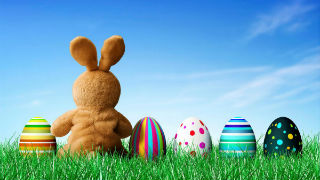 The Easter Bunny is a symbol of Easter that is popular in western culture, especially with children. According to folklore, the Easter Bunny hides Easter eggs for children to find on Easter morning... continue reading

 He is not here, for he has been raised just as he said. - Matthew 28:6. Learn more about the Post-Resurrection Appearances of Jesus Christ... continue reading
 Catholic Online Shopping offers a variety of Easter gifts & Easter treats for all ages! Choose a gift for someone special and celebrate the joy of Easter... continue reading
Easter / Lent News
5 Beautiful scriptures to remind you what Easter is all about Watch
This Easter, make sure to take a moment with your family to thank Jesus for his amazing sacrifice. LOS ANGELES, CA (Catholic Online) - Turn ... continue reading
Good Friday: The Crucifixion of Jesus Christ, the Church and the Sacraments Watch
We will soon commemorate Good Friday. This is the day when the whole world stands still. We will recall the great Sacrifice offered on the ... continue reading

The surprising origins of the Easter Bunny -- it's not what you think! Watch

The Easter Bunny is a symbol of Easter that is popular in western culture, especially with children. According to folklore, the Easter ... continue reading
The Sacred Triduum: Holy Thursday, Good Friday and Easter. The Mystery of Faith Watch
"Beginning with the Easter Triduum as its source of light, the new age of the Resurrection fills the whole liturgical year with its ... continue reading
Footwashing, the Holy Thursday Mandatum: God is Love and Love is a Verb Watch
As we enter into these three days, the one day, we make this mystery our own. No mere spectators in this Act of Love we become ... continue reading

Come Grow With Us
Sign up and walk the Catholic journey with millions around the world.
Receive inspiring emails on saints, daily readings, and free faith-building resources—no cost, ever.
Sister Sara Has One Message for Every Catholic Family This June
- Easter / Lent
- 5 Lenten Prayers
- Ash Wednesday
- 7 Morning Prayers
- Mysteries of the Rosary
- Litany of the Bl. Virgin Mary
- Popular Saints
- Popular Prayers
- Female Saints
- Saint Feast Days by Month
- Stations of the Cross
- St. Francis of Assisi
- St. Michael the Archangel
- The Apostles' Creed
- Unfailing Prayer to St. Anthony
- Pray the Rosary








Copyright 2026 Catholic Online. All materials contained on this site, whether written, audible or visual are the exclusive property of Catholic Online and are protected under U.S. and International copyright laws, © Copyright 2026 Catholic Online. Any unauthorized use, without prior written consent of Catholic Online is strictly forbidden and prohibited.
Catholic Online is a Project of Your Catholic Voice Foundation, a Not-for-Profit Corporation. Your Catholic Voice Foundation has been granted a recognition of tax exemption under Section 501(c)(3) of the Internal Revenue Code. Federal Tax Identification Number: 81-0596847. Your gift is tax-deductible as allowed by law.