 Dear readers, Catholic Online was de-platformed by Shopify for our pro-life beliefs. They shut down our Catholic Online, Catholic Online School, Prayer Candles, and Catholic Online Learning Resources essential faith tools serving over 1.4 million students and millions of families worldwide. Our founders, now in their 70's, just gave their entire life savings to protect this mission. But fewer than 2% of readers donate. If everyone gave just $5, the cost of a coffee, we could rebuild stronger and keep Catholic education free for all. Stand with us in faith. Thank you. Help Now >
THURSDAY HOMILY: The Way of Simplicity. Learning to See Lazarus
FREE Catholic Classes
Simplicity strips away only what impedes love. In finding our proper relationship to the goods of the earth-not utterly rejecting them, craving them, or turning them into an idol-we find true freedom. Our eyes are opened. We not only learn to see Lazarus, we see Jesus in Lazarus.

Highlights
Catholic Online (https://www.catholic.org)
3/1/2013 (1 decade ago)
Published in Year of Faith
Keywords: simplicity, evangelical counsels, voluntary poverty, poverty of spirit, holiness, Bosom of Abraham, Lazarus and the Rich man, contemplation, contemplative, Yesr of Faith, Deacon Keith Fournier
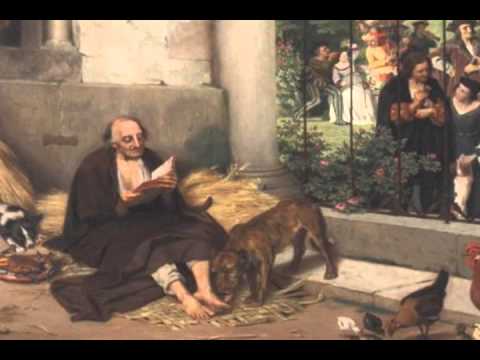
P>CHESAPEAKE, VA. (Catholic Online) - In today's Gospel we encounter a rich man who embraces a wrong relationship with the goods of the earth. Instead of offering these goods back to the Lord who is their Source and using them to serve others - his disordered appetites entrap and blind him. His sin is that he failed to see the need of his brother.
"Jesus said to the Pharisees: "There was a rich man who dressed in purple garments and fine linen and dined sumptuously each day. And lying at his door was a poor man named Lazarus, covered with sores, who would gladly have eaten his fill of the scraps that fell from the rich man's table. Dogs even used to come and lick his sores. When the poor man died, he was carried away by angels to the bosom of Abraham."
"The rich man also died and was buried, and from the netherworld, where he was in torment, he raised his eyes and saw Abraham far off and Lazarus at his side. And he cried out, 'Father Abraham, have pity on me. Send Lazarus to dip the tip of his finger in water and cool my tongue, for I am suffering torment in these flames.' Abraham replied, 'My child, remember that you received what was good during your lifetime while Lazarus likewise received what was bad; but now he is comforted here, whereas you are tormented."
"Moreover, between us and you a great chasm is established to prevent anyone from crossing who might wish to go from our side to yours or from your side to ours.' He said, 'Then I beg you, father, send him to my father's house, for I have five brothers, so that he may warn them, lest they too come to this place of torment.'
"But Abraham replied, 'They have Moses and the prophets. Let them listen to them.' He said, 'Oh no, father Abraham, but if someone from the dead goes to them, they will repent.' Then Abraham said, 'If they will not listen to Moses and the prophets, neither will they be persuaded if someone should rise from the dead.' (Luke 16: 19-31)
The Lord said nothing about the rich man's possessions. It was his wrongful use of them he addressed. The Rich Man failed to recognize the need of others. St Augustine proclaimed in a homily on this Gospel passage: "Lazarus was received into heaven because of his humility and not because of his poverty. Wealth itself was not what kept the rich man from eternal bliss. His punishment was for selfishness and disloyalty" Having goods is not sin. It is whether they have us. In this parable, goods have the man.
In an age of bumper stickers such as "Whoever dies with the most toys wins" and "I am spending my retirement spending my children's inheritance", Christians are called to a different approach to the goods of the earth. We are invited to embrace simplicity of life. Simplicity is not about the quantity of the goods of the earth we possess. It is about our relationship to them. Jesus said, "Where your treasure is, there your heart will be also" (Matt. 6:21). How often have we have heard the saying, "Money is the root of all evil"? That is not what the Apostle taught.
Money is not evil. Nor is it proof of God's blessing and favor-a view that insults Christians who struggle daily to survive. Both errors are rooted in a mistaken foundation. They are self-centered rather than God and other centered. The Apostle Paul wrote two letters to Timothy, a young disciple who had been placed in leadership over the Christian community at Ephesus, a city known for its wealth and luxury. St. Paul traveled there to plant the nascent Christian Church. Knowing that those Christian believers would face certain dangers when dealing with wealth, he reminded Timothy:
"Indeed, religion with contentment is a great gain; for we brought nothing into the world, just as we shall not be able to take anything out of it. If we have food and clothing, we shall be content with that. Those who want to be rich are falling into temptation and into a trap and into many foolish and harmful desires, which plunge them into ruin and destruction.For the love of money is the root of all evils - and some people in their desire for it have strayed from the faith and have pierced themselves with many pains. But you, man of God, avoid all this. Instead, pursue righteousness, devotion, faith, love, patience, and gentleness." (1 Tim. 6: 6-11)
The phrase "love of money" speaks to the heart. When we love the goods of the earth more than we love the One who created them, we commit the sin of idolatry. A destitute person can be just as obsessed with money as a wealthy one who is given over to greed. Greed is a form of idolatry.
In another letter to the Christians in Philippi, St Paul explains his own approach to material things: "I know indeed how to live in humble circumstances; I know also how to live with abundance. In every circumstance and in all things I have learned the secret of being well fed and of going hungry, of living in abundance and of being in need" (Philippians 4:12). Paul was free from the love of money.
The Gospels of Matthew and Mark describe an encounter between Jesus and a wealthy young man. This man had followed the commandments since his youth, but Jesus told him it was not enough. He instructed the young man to give up his possessions and follow Him. We read that the man refused and went away sad because his possessions possessed him.
Consider the sobering words which follow this encounter: "Then Jesus said to his disciples, 'Amen, I say to you, it will be hard for one who is rich to enter the kingdom of heaven. Again I say to you, it is easier for a camel to pass through the eye of a needle than for one who is rich to enter the kingdom of God.' When the disciples heard this, they were greatly astonished and said, 'Who then can be saved?' Jesus looked at them and said, 'For human beings this is impossible, but for God all things are possible.' (Matthew 19, Mark 10).
When we recognize our own poverty of spirit we are able to live lives that are dependent upon Jesus. Only He can satisfy the hunger of the human heart. When we have Him, we have everything; even though we may possess nothing. We discover the secret of heaven's economy: those who live in simplicity are the richest people on the earth. Jesus called them the "poor in spirit." He promised them blessedness. He proclaimed that the kingdom of heaven belongs to them (Matt 5:3).
Some Christians are called to a voluntary embrace of economic poverty as part of a specific vocation. However, most of us live in the material world of bills, possessions, and financial challenges. We are to receive them with gratitude and use them with the freedom which comes from a relationship with the Lord. Our relationship to this world - and the goods of this world- should mirror that of God's Son whom we follow. Jesus was born in a manger. As an adult he had no place to lay his head. He was raised in a simple home- by a woman whose heart recognized true wealth.
Remember the words that the angel spoke to Mary when she asked how it could be that she would bear the Messiah. "Nothing is impossible with God" (Luke 1:37) Mary understood that when you have the Lord, you have it all. She lived in the heavenly economy, and if we choose, we can live there too. There is an invitation to simplicity in Gods loving plan for each one of us. To those who voluntarily embrace it, simplicity becomes an invitation to love, and a school of sanctity. All relationships, with persons as well as with the goods of the earth, are changed by its embrace.
Painful experiences can become the material for personal transformation and enable us to open ourselves to the fullness of life. Through simple surrender to the loving plan of God, we enter into communion with the Lord and experience His loving gaze. Fear dissipates and everything is bathed in love. The way of simplicity paves a path to peace. The capacity to see life differently comes through from prayer. Contemplatives comprehend, or rather, are comprehended by, the experience of communion with the Lord. They fall in love with God and need nothing else.
Father Louis (Thomas Merton) wrote on November 10, 1963, "Whatever I may have written, I think it all can be reduced in the end to this one root truth: that God calls human persons to union with Himself and with one another in Christ, in the Church which is His Mystical Body. It is also a witness to the fact that there is and must be, in the church, a contemplative life which has no other function than to realize these mysterious things, and return to God all the thanks and praise that human hearts can give Him."
Simplicity strips away only what impedes love. In finding our proper relationship to the goods of the earth-not utterly rejecting them, craving them, or turning them into an idol-we find true freedom. Our eyes are opened. We not only learn to see Lazarus, we see Jesus in Lazarus.
---
'Help Give every Student and Teacher FREE resources for a world-class Moral Catholic Education'
Copyright 2021 - Distributed by Catholic Online
Come Grow With Us
Sign up and walk the Catholic journey with millions around the world.
Receive inspiring emails on saints, daily readings, and free faith-building resources—no cost, ever.
Sister Sara Has One Message for Every Catholic Family This June
- Easter / Lent
- 5 Lenten Prayers
- Ash Wednesday
- 7 Morning Prayers
- Mysteries of the Rosary
- Litany of the Bl. Virgin Mary
- Popular Saints
- Popular Prayers
- Female Saints
- Saint Feast Days by Month
- Stations of the Cross
- St. Francis of Assisi
- St. Michael the Archangel
- The Apostles' Creed
- Unfailing Prayer to St. Anthony
- Pray the Rosary








Copyright 2026 Catholic Online. All materials contained on this site, whether written, audible or visual are the exclusive property of Catholic Online and are protected under U.S. and International copyright laws, © Copyright 2026 Catholic Online. Any unauthorized use, without prior written consent of Catholic Online is strictly forbidden and prohibited.
Catholic Online is a Project of Your Catholic Voice Foundation, a Not-for-Profit Corporation. Your Catholic Voice Foundation has been granted a recognition of tax exemption under Section 501(c)(3) of the Internal Revenue Code. Federal Tax Identification Number: 81-0596847. Your gift is tax-deductible as allowed by law.