Saint Teresa of Avila: Virgin and Doctor of Prayer
St. Teresa's whole life is one of simple beauty and fervent purpose; it is a life contained in Christ. She shows us how to live the same way through Prayer.On reading from St. Teresa, a deep feeling of her love for His Majesty envelops us; we begin, in a very real, tangible manner, to taste the love and dedication she held for God in our own heart. Further, is that not what all the saints do? That is, do they not draw us toward God as they march in front as warriors for the Faith? We have a great deal to learn from St. Teresa
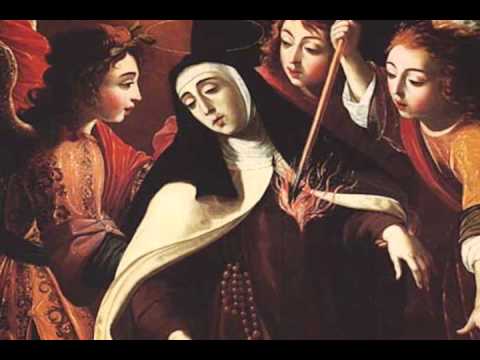

Highlights
Catholic Online (https://www.catholic.org)
10/15/2014 (1 decade ago)
Published in Christian Saints & Heroes
Keywords: Saint Teresa of Avila, Doctor of the Church, holiness, women saints, virtue, universal call to holiness, prayer, contemplation, Saint Teresa of Avila
GLADE PARK, Colorado (Catholic Online) - Teresa Sanchez Cepeda Davila y Ahumada was born on a Wednesday morning in the Castilian town of Avila, March 28, 1515. She was the third of nine children. Her mother, Dona Beatriz Davila y Ahumada, a woman of great understanding and virtue, died while St. Teresa had but reached only her thirteenth year. She describes her father as a virtuous man, always chaste, who carefully and joyfully followed the Lord's commandments.
As a youngster, St. Teresa had a strong devotion to St. Joseph and Our Lady, often finding a quiet place in the house to pray the Rosary. She had a favorite brother who was close to her own age; they enjoyed reading the lives of the saints together, and, one day, decided the quickest path to heaven was that of martyrdom. St. Teresa says of this, "I used to think that they [the martyrs] had bought their entry into God's presence very cheaply. Then I fervently longed to die like them, not out of any conscious love for Him, but in order to attain as quickly as they had those joys which, as I read, are laid up in Heaven" (The Life of Saint Teresa of Avila by Herself, Penguin Classics, 1957, p. 24).
Enjoy this exquisite medal dedicated to St. Theresa of Avila.
She notes that, as she grew into a teen, vanity, idle companionship, and unfruitful reading caused her harm. As for her interest in books, she comments: "I was so enthralled by it that I do not believe I was ever happy if I had not a new book" (Ibid., p. 26). St. Teresa often relates of her sorrow for those teenage years, as well as some years beyond them, when she had not yet given herself completely to her beloved Jesus; even writing of a vision of hell, in which she experienced a horrifying place that she believed had been prepared for her as her eternal residence had not our Lord Jesus rescued her.
At age sixteen, though happily acting as a boarder in the Augustinian Convent of Avila, St. Teresa had no interest in becoming a nun. Yet under the influence of Sister Maria Briceno, a holy and pious woman, St. Teresa's love for prayer and holiness grew stronger. After an illness which required her to return home, she visited with her uncle, read some spiritual books he had, and, after three months of spiritual conflict, decided to become a nun. After reading from St. Jerome, she found the courage to tell her father of her plans, though he was opposed to the idea. St. Teresa, at age twenty-one, quietly entered the Carmelite Convent of the Incarnation at Avila in November, 1536. St. Teresa spent, chiefly, the next twenty years at this convent.
During her life in the Carmelite Convent, St. Teresa struggled with her spiritual growth, yet, through persistence and love and over the course of many years, her union with God would flourish. She would experience unfathomable spiritual graces: locutions, transports, visions, and levitations - her soul would reach spiritual maturity.From about 1562 to 1582, St. Teresa traveled Spain founding 17 convents; the last of which was at Burgos, Spain, in April, 1582. At the request of her confessors, she wrote one of the greatest works on prayer, her autobiography, best known as The Life of Saint Teresa of Avila by Herself, which she completed in 1565.
According to J. M. Cohen, who wrote the introduction, her autobiography is the most widely read prose classic of Spain. This work, considered one of her most important, explained many aspects of her life in the convent: her struggles with the sins of her past life; her constant pursuit of virtue and holiness; the distress the devil caused her; suffering inflicted by inexperienced confessors; and the ways in which God granted her mercy and wondrous mystical graces.Among one of the most important aspects of St. Teresa's autobiography is her account of the four stages of prayer. St. Teresa teaches "beginners", as she refers to them, the way in which they might attain, with God's grace, higher levels of perfection, holiness, and prayer. It is a book in which the devout and properly disposed soul may achieve great profit; for its descriptive language is simple, beautiful, and readily understandable.
One thing is certain, St. Teresa never lost sight of her reliance on God, her need for Christ, and the sins of her past life. Of her sins, in her usual candid and warm style, she writes: "I wish [in the autobiography] that I had been allowed to describe also, clearly and in full detail, my grave sins and the wickedness of my life. This would have been a great comfort to me, but I may not do so. In fact, I have been put under severe restrictions in the matter" (Ibid., p. 21). Even so, St. Teresa often took the opportunity to relate in a revealing manner her view of herself. Certainly the most important element of St. Teresa's teaching is the way to perfection; that is, the method of living a life of prayer and virtue with one goal in mind: God's love. She is careful to guide "beginners" along the proper path, warning them of the many dangers, the evil intent of the Devil, and other obstacles which commonly prevent souls from advancing in prayer.
She describes a wonderful insight she received on the day she took the habit at the Convent of the Incarnation, outside the walls of Avila: "When I took the habit the Lord immediately showed me how He favours those who do violence to themselves in order to serve Him. No one saw what I endured, . . . At the moment of my entrance into this new state I felt a joy so great that it has never failed me even to this day; and God converted the dryness of my soul into a very great tenderness" (Ibid., p. 33).One of St. Teresa's most well known metaphors concerning prayer is the one in which she describes meditation as similar to cultivating a spiritual garden. She says of this: "A beginner must look on himself as one setting out to make a garden for his Lord's pleasure, on most unfruitful soil which abounds in weeds. His Majesty roots up the weeds and will put in good plants instead. Let us reckon that this is already done when the soul decides to practice prayer and has begun to do so" (Ibid., p. 78).
St. Teresa, Doctor of Prayer, is always careful to guide souls that they should diligently set themselves to prayer, not allowing discouragement to hinder them. She says of the worth of mental prayer: "It is of special note, that the soul which begins resolutely to tread this path of mental prayer, and can manage not greatly to care about consolations and tenderness in devotion, neither rejoicing when the Lord gives them nor being discouraged when He withholds them, has already gone a large part of the way" (Ibid., p. 81).
Note that when St. Teresa speaks of mental prayer, she speaks of our Lord as our focus, an important point some overlook. Prayer is man relating to and conversing with God, the All-Holy Creator; therefore, as with true religion, the first act of prayer ought to be adoration. The Catechism of the Catholic Church tells us: "Adoration is the first act of the virtue of religion. To adore God is to acknowledge him as God, as the Creator and Savior, the Lord and Master of everything that exists, as infinite and merciful Love. 'You shall worship the Lord your God, and him only shall you serve,' says Jesus, citing Deuteronomy" (2096).
It is necessary to maintain and guard a proper perspective during prayer. Who is it to whom we pray? It is "His Majesty", as St. Teresa often addressed Him, the Giver of life and immortality, our God who first created us and now sustains us. She would tell us to be mindful of the fact that we are speaking with God. The Catechism explains: "In the first place, we ought to be astonished by this fact: when we praise God or give him thanks for his benefits in general, we are not particularly concerned whether or not our prayer is acceptable to him. On the other hand, we demand to see the results of our petitions. What is the image of God that motivates our prayer: an instrument to be used? or the Father of our Lord Jesus Christ?" (2735).
There are some who, coversing with God throughout the day, hope they are engaging in prayer but then refrain from setting a time to engage in prayer with purpose and dedication. Certainly God is aware of all we say and do and is eager for our conversation and communion. However, however, prayer is to involve more.The Catechism explains:"Prayer cannot be reduced to the spontaneous outpouring of interior impulse: in order to pray, one must have the will to pray. Nor is it enough to know what the Scriptures reveal about prayer: one must also learn how to pray. Through a living transmission (Sacred Tradition) within "the believing and praying Church," the Holy Spirit teaches the children of God how to pray" (2560).
Those who desire to advance in prayer yet ignore Sacred Tradition, who think little of submitting in obedience to the "believing and praying Church" can injure themselves. One does not walk with God in disobedience to the Catholic Church which He willed should exist. Who among us would be so dull-witted as to say to our Lord, "I want to walk with you, but I don't believe anything you say." Submitting in obedience to the Church was always a concern of the utmost seriousness for St. Teresa. "If I should say anything that is not in conformity with what is held by the Holy Roman Catholic Church, it will be through ignorance and not through malice. This may be taken as certain, and also that, through God's goodness, I am, and shall always be, as I always have been, subject to her" (Interior Castle, Teresa of Avila, Image Books, 1961, p. XXIX).
In directing souls, St. Teresa, in every book she has written, is unfailingly careful to mention the perils of mortal sin: "And, since this soul has separated itself from Him, it cannot be pleasing in His eyes; for, after all, the intention of a person who commits a mortal sin is not to please Him but to give pleasure to the devil; and, as the devil is darkness itself, the poor soul becomes darkness itself likewise. . . . When the soul, through its own fault, . . . becomes rooted in a pool of pitch-black, evil smelling water, it produces nothing but misery and filth" (Ibid., p.10).In an age when many abuses and novel notions of what passes for "spirituality" appeal to so many, we are in dire need of St. Teresa's clarity of teaching. She has a way of returning us, again and again, to the foundation of prayer - "His Majesty". We owe our Lord a great debt of gratitude for bringing us our cherished Doctor of Prayer, with her ability to express the tenets of prayer in such eloquent, wonderful words, which can be readily grasped by all who are interested.

Fr. Christopher Rengers notes that Pope Paul VI (1963-1978), on speaking of the importance of St. Teresa's work concerning prayer, stated with magnificent precision of the need for her message of prayer in today's world:
"Teresa's message of prayer comes to us children of the Church at a time marked by a great effort at reform and renewal of liturgical prayer. It comes to us who are tempted by the great noise and business of the outside world to yield to the frenzy of modern life and to lose the real treasures of our souls in the effort to win earth's seductive treasures. It comes to us, children of our time, just when we are losing, not only the habit of conversation with God, but also the sense of the need and duty to worship and call on Him . . . Psychoanalytical exploration is breaking down the frail and complicated instrument that we are, in such a way that all that can be heard is, not the sound of mankind in its suffering and its redemption, but rather the troubled mutterings of man's animal subconscious, the cries of his disordered passions and his desperate anguish" (33 Doctors of the Church, p. 436-37).
St. Teresa taught that along with prayer one must strive to lead a virtuous life. The path of virtue is one of frequent confession, prayer and Eucharist; including a firm resolution to avoid all venial sin. Grave sin, of course, is to be avoided at all costs. So, what we learn is that the way of perfection consists in living the Catholic life with fervor and diligence, always and everywhere. As the soul finds itself rising to the heights through the cultivation of virtue, prayer and love, attaining to advanced prayer and receiving the unfathomable consolations which, as St. Teresa tells us, are granted to those whose virtue has reached perfection, the person experiences the realization that the world and all that is in it is are as nothing.
St. Teresa relates it this way: "On arriving at this state, the soul begins to lose the desire for earthly things - and no wonder! It clearly sees that not even one moment of this joy is to be obtained here on earth, and that there are no riches, estates, honours, or delights that can give it such satisfaction even for the twinkling of an eye. . . . the soul [will] realize that He [God] is so near to it that it need not send messengers, but may speak to Him itself. Nor need it cry aloud, since He is now so close that it has only to move its lips and He will understand" (Ibid., p. 99).
After being suddenly drawn into rapture and experiencing a vision of heaven, St. Teresa tells us this event was "accompanied by a joy so sublime as to be indescribable. All the senses are filled with such a profound bliss and sweetness that no description is possible. It is better, therefore, to say no more about this" (Ibid., p.284).St. Teresa's whole life is one of simple beauty and fervent purpose; it is a life contained in Christ; it is a life of service and humility, fully submitting to "His Majesty" and the Catholic Church he founded, the Bride of Christ.
On reading from St. Teresa, a deep feeling of her love for His Majesty envelops us; we begin, in a very real, tangible manner, to taste the love and dedication she held for God in our own heart. Further, is that not what all the saints do? That is, do they not draw us toward God as they march in front as warriors for the Faith? We have a great deal to learn from St. Teresa. No Catholic family should remain ignorant of her wonderful works on prayer. After reading her simple, profound and touching words, Catholics around the world truly feel as though they love her. And so it is. The community of Christ's Mystical Body truly loves this great saint, Teresa of Avila, Doctor of Prayer.
After having founded the convent at Burgos, near the end of July, 1582, St. Teresa of Avila died at the Carmelite convent at Alba de Tormes at about 9:00 p.m. She had not made it back to Avila. Giving thanks to God for his many graces, voicing her love of holy mother Catholic Church, St. Teresa repeated over and over again, "I am a daughter of the Church." At the time of her death, a sweet odor pervaded the room in which her body lay; so strong was the odor that it was found necessary to open windows, allowing outside air to dilute the intoxicating fragrance.
St. Teresa was canonized in 1622, a scant forty-five years after her death. Pope Paul VI, on September 27, 1970, officially declared the Carmelite nun to be the first woman Doctor of the Church.
"It is no small pity, and would cause us no little shame, that, through our own fault, we do not understand ourselves, or know who we are. Would it not be a sign of great ignorance, my daughters, if a person were asked who he was, and could not say, . . . though that is great stupidity, our own is incomparably greater if we make no attempt to discover what we are, and only know that we are living in these bodies, and have a vague idea, because we have heard it and because our Faith tells us so, that we possess souls. . . . All our interest is centered in the rough setting of the diamond, and the outer wall of the castle - that is to say, in these bodies of ours" (Interior Castle, p. 4). - St. Teresa of Avila; Virgin, Doctor of Prayer.

-----
Deacon F. K. Bartels is a Catholic writer who knows his Catholic Faith is one of the greatest gifts a man could ever receive. He is a contributing writer for Catholic Online. Visit him also at www.joyintruth.com
---
'Help Give every Student and Teacher FREE resources for a world-class Moral Catholic Education'
Copyright 2021 - Distributed by Catholic Online
Come Grow With Us
Sign up and walk the Catholic journey with millions around the world.
Receive inspiring emails on saints, daily readings, and free faith-building resources—no cost, ever.
Sister Sara Has One Message for Every Catholic Family This June
- Easter / Lent
- 5 Lenten Prayers
- Ash Wednesday
- 7 Morning Prayers
- Mysteries of the Rosary
- Litany of the Bl. Virgin Mary
- Popular Saints
- Popular Prayers
- Female Saints
- Saint Feast Days by Month
- Stations of the Cross
- St. Francis of Assisi
- St. Michael the Archangel
- The Apostles' Creed
- Unfailing Prayer to St. Anthony
- Pray the Rosary








Copyright 2026 Catholic Online. All materials contained on this site, whether written, audible or visual are the exclusive property of Catholic Online and are protected under U.S. and International copyright laws, © Copyright 2026 Catholic Online. Any unauthorized use, without prior written consent of Catholic Online is strictly forbidden and prohibited.
Catholic Online is a Project of Your Catholic Voice Foundation, a Not-for-Profit Corporation. Your Catholic Voice Foundation has been granted a recognition of tax exemption under Section 501(c)(3) of the Internal Revenue Code. Federal Tax Identification Number: 81-0596847. Your gift is tax-deductible as allowed by law.