We ask you, urgently: don't scroll past this
Dear readers, Catholic Online was de-platformed by Shopify for our pro-life beliefs. They shut down our Catholic Online, Catholic Online School, Prayer Candles, and Catholic Online Learning Resources essential faith tools serving over 1.4 million students and millions of families worldwide. Our founders, now in their 70's, just gave their entire life savings to protect this mission. But fewer than 2% of readers donate. If everyone gave just $5, the cost of a coffee, we could rebuild stronger and keep Catholic education free for all. Stand with us in faith. Thank you.Help Now >
Converging and Convincing Proof of God: If Truth, Then God
FREE Catholic Classes
If there is such a thing as the truth, what is it in us capable of finding find it? Finally, if there is such a thing as the truth, and we have the faculty to find the truth, then does that mean that there may be a Truth behind the truth we discover? If the answers to these questions are yes, this takes us to the threshold of faith whereupon we ask the question: "Is this truth a Person?" "Does He have a name?"

Highlights
Catholic Online (https://www.catholic.org)
11/10/2012 (1 decade ago)
Published in Year of Faith
Keywords: apologetics, truth, faith, ontology, Andrew M. Greenwell, Esq.,
CORPUS CHRISTI, TX (Catholic Online) - "What is truth?" famously stated Pontius Pilate to Jesus who had proclaimed himself to be "the Truth." (Cf. John 18:38; John 14:6). As an unbelieving pagan blind to the Incarnate Truth before him, the Roman procurator was oblivious of the irony in his words.
Pilate, it should be noted, was not asking Jesus the question as a philosopher or a religious seeker. He was asking the question as a human judge, as the holder of authority, of temporal power. "Don't you realize I have the power either to free you or to crucify you?" (John 19:10).
Truth, however, does not rely on human or temporal power. Truth and temporal power are altogether different categories. Whether freed or crucified, Truth remains what it is: Truth.
It is a mistake of tyrants to believe that power makes truth, that might makes right. It is a mistake of the advocates of democracy to believe that the majority makes truth, that the majority makes right.
In fact, it is more than a mistake; it is a lie. The cross is a reminder of that.
He who, from a temporal perspective, appeared to be the least powerful man in the world, a man adjudged guilty of a capital offense, bound with nails to the wood of the cross as a result of Pilate's power and the blind finagling of the religious powers of the day, was, in fact, God the Truth, God the Good.
On the Cross, Jesus was a minority of one. Unus Christus contra mundum. And though a minority of one, He is the sole Truth, and there is no other, no matter how many votes, like the lots of the Roman soldiers, are cast against him.
There is a common saying among trial lawyers which sort of reflects Pilate's concept of truth. The old saw goes that there is the plaintiff's "truth," there is the defendant's "truth," there is the jury's "truth," and then there is the truth, which apparently is impossible to know and irrelevant to practical decision-making. Under this view, the legal or political system is unconcerned with the truth, not unlike Pontius Pilate was unconcerned with truth.
The cynicism of lawyers and procurators and politicians and voters aside, however, is there such a thing as the truth, something above and beyond the fickle and tendentious "truth" which is nothing other than opinion or nothing other than what is to one's advantage?
If there is such a thing as the truth, what is it in us capable of finding find it? Finally, if there is such a thing as the truth, and we have the faculty to find the truth, then does that mean that there may be a Truth behind the truth we discover? If the answers to these questions are yes, this takes us to the threshold of faith whereupon we ask the question: "Is this truth a Person?" "Does He have a name?"
The effort to answer these three questions led St. Augustine to a proof of God's existence. The proof is set forth in its most complete form in the dialogue he wrote entitled De Libero Arbitrio (On Free Will).
Relying on St. Augustine's insights in this dialogue allows us to propose another "converging and convincing" proof of God: if truth, then God.
Before we turn to truth, we have to start with skepticism, if only to depart from it. Skepticism is a self-defeating proposition. It is nonsensical to say that there is no truth except that there is no truth. It is absurd to say all truths are relative, except that truths are relative. It is the same as saying all colors are black, except black. This absurdity is the heart of skepticism. It is therefore an intellectual cul-de-sac unworthy of any but the feeblest of minds.
The one thing Augustine did not have was a feeble mind. He knew that even the failure to grasp the truth proves at least one certainty, namely that one exists and that the truth exists since one recognizes that one has failed to attain it. Si fallor sum. Even if I am mistaken, I am. That is a truth that all should recognize.
In his famous dialogue De Libero Arbitrio, using the vehicle of a conversation between him and a certain Evodius, St. Augustine addresses the issue of whether there is such a thing as truth, whether man is capable of attaining truth, and whether the existence of truths means necessarily points to the existence of God.
St. Augustine begins his exploration by observing that there are three levels of existence, of being, each more comprehensive than the level before it.
There is being (esse) in the most general sense, a reality man shares with inanimate objects such as a rock. There is living (vivere), a form of being that that man shares with plants and animals. There is finally the highest form of being, knowing or understanding (intelligere). This faculty of knowing or understanding allows us to have an awareness of what is outside of us, what is inside us (self awareness), and to comprehend and therefore understand both.
This faculty of knowing which we call reason and which we find within ourselves we recognize also to be a leap in being because it exceeds both being and living. It is able to stand in judgment of things that are and things that live. The faculty of knowing allows us to understand and therefore transcend simple being and living. It appears to be a spiritual sort of faculty, and it is the greatest, most noble existence that we experience.
This experience of knowing (intelligere) and the experience that it exceeds both living (vivere) and being (esse) is the foundation from which, following St. Augustine, we may venture, using the illative sense, to come to a conclusion that God exists.
We know through experience that knowing (intelligere) is the greatest faculty within us. The question then arises: is there is something that exists that is superior and external to man's intellect, and, what is more, is also eternal and immutable? If so, would that being not be God?
To answer these questions, St. Augustine points to truths that are shared by all men and women. There are some self-evident as well as other truths, both practical and theoretical, that we all share: "Do good, avoid evil," or "one and the same thing cannot both be and not be in the same sense at the same time," or even "7 + 3 = 10."
Now, is the truth within you that "7 + 3 = 10," and the truth within me that "7 + 3 =10," and the truth within St. Augustine that "7 + 3 =10," different truths or the same truth?
Do we not recognize that it is one and the same truth? And do we not recognize that, even if an infant does not recognize the truth, "7 + 3 = 10," or that if a skeptic insists that he is unsure whether "7 + 3 = 10," that the truth that "7 + 3 = 10" is nevertheless true?
Augustine suggests that what is true for numbers is true for wisdom. There are "shared truths" that pertain to wisdom also, such as the better is to be preferred to the worse, the eternal is to be preferred to the ephemeral, and something cannot both be and not be in the same way at the same time.
These shared truths are something separate from our minds because they are not subject to change as our minds are. In St. Augustine's words:
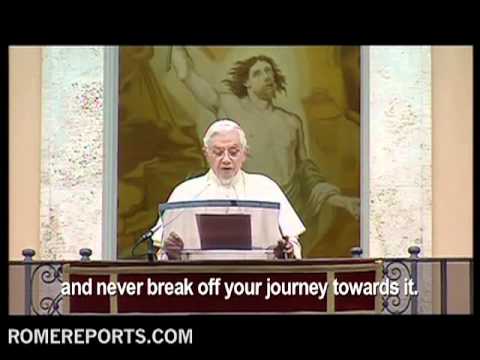
"If this truth were on par with our minds, it would itself be subject to change. Sometimes our minds see it more clearly, sometimes less clearly, and as a result our minds admit themselves to be subject to change. The truth, however, abiding in itself, gains nothing when we see it more clearly, and loses nothing when we see it less clearly, but, whole and sound, it gladdens with its light those who are turned towards it, and punishes with its blindness those who are turned away from it."

Now if these shared truths are true irrespective of our judgment, it would seem that they are superior to our intellect. This suggests that these shared truths are greater than our intellect since the intellect must conform to these shared truths, and not the shared truths to our intellect.
This truth appears to have the same characteristics as God:
"It is in no place, yet nowhere is it absent; from without it admonishes us, within it instructs us. It changes all its beholders for the better; it is itself never changed for the worse; without it, no one judges right."
Our experience therefore indicates that these shared truths point to a truth external from us that is immutable and, what is more eternal. These shared truths do not change and will never change, and so behind these shared truths there appears to be a truth which is immutable and eternal and to which we ought to conform. This truth is God, or if there is something even higher than this truth, then this something higher is God. In either event, God exists.
If truth, then God.
There is an inextricable link between truth, our faculty to recognize it, our search for truth, and God. This is St. Augustine's argument.
It was an argument from experience. He tells us in his autobiographical Confessions that, from the age of nineteen when he happened upon Cicero's treatise Hortensius during the course of his rhetorical studies, he was convinced that happiness was found in wisdom.
Cicero's treatise, St. Augustine says, was an "exhortation to philosophy," and the effect of Cicero's treatise on the young Augustine was such that it filled him with a magnum incendium, a "burning desire," to devote himself to acquiring wisdom. At the time ignorant of, or perhaps better oblivious to, Christ, he was nevertheless "enkindled and inflamed to love, to seek, to obtain, to hold, and to embrace, not this or that sect, but wisdom itself, wherever it might be."
Eventually, the quest for happiness through wisdom brought him to the Incarnate Word, Jesus. And when St. Augustine put his faith in Jesus, he found out that Jesus was the fulfillment of all his yearnings, that satisfaction of all his hopes. His only sorrow was that he did not come upon him early enough. Too late did he begin to love the Truth who had a name!
St. Edith Stein, whose own pilgrimage in truth led her from philosophy to Jesus and to becoming a Carmelite nun and taking the name Sister Teresa Benedicta of the Cross, traveled on this Augustinian road to God. As John Paul II stated in his Homily for her canonization on October 11, 1998:
"The love of Christ was the fire that inflamed the life of St Teresa Benedicta of the Cross. Long before she realized it, she was caught by this fire. At the beginning she devoted herself to freedom. For a long time Edith Stein was a seeker. Her mind never tired of searching and her heart always yearned for hope. She traveled the arduous path of philosophy with passionate enthusiasm. Eventually she was rewarded: she seized the truth. Or better: she was seized by it. Then she discovered that truth had a name: Jesus Christ. From that moment on, the incarnate Word was her One and All. Looking back as a Carmelite on this period of her life, she wrote to a Benedictine nun: 'Whoever seeks the truth is seeking God, whether consciously or unconsciously.'"
Would that the fire for truth, the burning desire for truth that seized the souls of St. Augustine of Hippo and St. Edith Stein, saints fifteen centuries apart, catch a hold of all of us and take us, consciously or unconsciously, into the path of the Truth who has a name. His name is Jesus.
-----
Andrew M. Greenwell is an attorney licensed to practice law in Texas, practicing in Corpus Christi, Texas. He is married with three children. He maintains a blog entirely devoted to the natural law called Lex Christianorum. You can contact Andrew at agreenwell@harris-greenwell.com.
---
'Help Give every Student and Teacher FREE resources for a world-class Moral Catholic Education'
Copyright 2021 - Distributed by Catholic Online

Come Grow With Us
Sign up and walk the Catholic journey with millions around the world.
Receive inspiring emails on saints, daily readings, and free faith-building resources—no cost, ever.
Sister Sara Has One Message for Every Catholic Family This June
- Easter / Lent
- 5 Lenten Prayers
- Ash Wednesday
- 7 Morning Prayers
- Mysteries of the Rosary
- Litany of the Bl. Virgin Mary
- Popular Saints
- Popular Prayers
- Female Saints
- Saint Feast Days by Month
- Stations of the Cross
- St. Francis of Assisi
- St. Michael the Archangel
- The Apostles' Creed
- Unfailing Prayer to St. Anthony
- Pray the Rosary










Copyright 2026 Catholic Online. All materials contained on this site, whether written, audible or visual are the exclusive property of Catholic Online and are protected under U.S. and International copyright laws, © Copyright 2026 Catholic Online. Any unauthorized use, without prior written consent of Catholic Online is strictly forbidden and prohibited.
Catholic Online is a Project of Your Catholic Voice Foundation, a Not-for-Profit Corporation. Your Catholic Voice Foundation has been granted a recognition of tax exemption under Section 501(c)(3) of the Internal Revenue Code. Federal Tax Identification Number: 81-0596847. Your gift is tax-deductible as allowed by law.