We ask you, urgently: don't scroll past this
Dear readers, Catholic Online was de-platformed by Shopify for our pro-life beliefs. They shut down our Catholic Online, Catholic Online School, Prayer Candles, and Catholic Online Learning Resources essential faith tools serving over 1.4 million students and millions of families worldwide. Our founders, now in their 70's, just gave their entire life savings to protect this mission. But fewer than 2% of readers donate. If everyone gave just $5, the cost of a coffee, we could rebuild stronger and keep Catholic education free for all. Stand with us in faith. Thank you.Help Now >
The Happy Priest on the Baptism of the Lord and our own Baptism
FREE Catholic Classes


Highlights
Catholic Online (https://www.catholic.org)
1/9/2017 (9 years ago)
Published in Year of Faith
Keywords: homily, homilies, sunday homily, baptism, father james farfaglia, Jesus
CORPUS CHRISTI, TX (Catholic Online) - We all celebrate our birthday with great joy. We have just celebrated the birthday of Jesus, certainly the greatest birthday of all. Now we are celebrating the feast of his baptism. But I wonder how many of us celebrate the anniversary of our baptisms? How many of us even know when we were baptized?
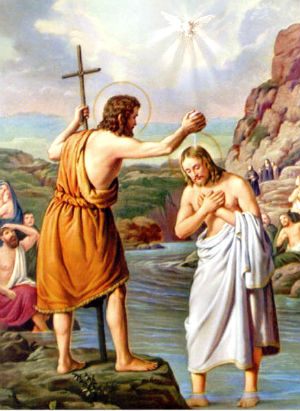
This Sunday, the liturgical season of Christmas comes to a conclusion with the celebration of the Baptism of the Lord. This is a time when we might ask ourselves why Jesus would allow himself to be baptized by John the Baptist and what practical applications might we make in our own lives.
There is a difference between the baptism of John the Baptist and the baptism that Jesus gives to us. The word baptism means to submerge in water. Baptism was not unknown to the Jewish people. Within the Jewish tradition there was a rite of immersion for legal purification for those who had become defiled under the Mosaic Law. Baptism was also used for Gentile converts to Judaism. Moreover, the Jewish Qumran, a community in existence during the time of Jesus, had been practicing baptism as a rite of initiation and purification over a period of years.
From the beginning John's baptism focused on conversion. His exhortations and appeals for personal repentance prepared the people to receive those graces which Christian baptism gives to us. While John's baptism, a ritualistic expression of conversion, penance and repentance, did not confer sanctifying grace, Jesus' baptism, a sacrament necessary for salvation, does bestow upon the baptized sanctifying grace.
Jesus had no need of conversion and repentance. He is the sinless one. So, why did Jesus allow himself to be baptized? There are a number of reasons that we can consider.
First of all, Jesus needs to make himself known to the Jewish people. A number of years ago, I had an opportunity to work in a mission territory in a very poor part of Mexico. Telephones, fax machines and email were not always available. Without these means of communication, which we take for granted, it was common to interact with people in a more personal manner.
Jesus walked the earth at a time when modern communication and the news media simply did not exist. A spiritual movement within the Jewish people was being stirred up by John the Baptist. It was very appropriate for Jesus to begin his public ministry by making his first public appearance precisely where John was baptizing. It is John the Baptist who announces to the crowds: "Behold, the Lamb of God!" (John 1: 36) Two of John's disciples are so moved by Jesus' appearance that they decide to become his disciples. Thus, Jesus uses the act of baptism as a means to make himself known to the people.
Secondly, the Lord's baptism is a moment of decision and identification. For thirty years he has faithfully carried out his Father's will in the ordinary circumstances of his hidden life. Now the Father is calling him to begin his public ministry. By being baptized, Jesus, although he is sinless, identifies himself with the very people that he has come to save.
At Calvary, Jesus takes the sin of the world upon himself. In a similar way, as he immerses himself in the waters of the Jordan, the sinless one takes upon himself the sins of humanity. Through his baptism, Jesus announces to the world that his public ministry has begun. In his humanity, he freely chooses to complete this mission and makes a free decision: he will carry out the Father's will to its' ultimate consequence. Through his baptism, Jesus identifies himself with all of us; i.e., sinful humanity, so that we can come to him filled with total confidence and peace.
It would be a mistake to consider, as some spiritual writers do, that Jesus was confused about his identity and did not know that he was the Messiah until his baptism in the Jordan. On this matter the Catechism of the Catholic Church is very clear.
"The unique and altogether singular event of the Incarnation of the Son of God does not mean that Jesus Christ is part God and part man, nor does it imply that he is the result of a confused mixture of the divine and the human. He became truly man while remaining truly God. Jesus Christ is true God and true man. During the first centuries, the Church had to defend and clarify this truth of faith against the heresies that falsified it" (# 464).
"This human soul that the Son of God assumed is endowed with a true human knowledge. As such, this knowledge could not in itself be unlimited: it was exercised in the historical conditions of his existence in space and time. This is why the Son of God could, when he became man, 'increase in wisdom and in stature, and in favor with God and man', and would even have to inquire for himself about what one in the human condition can learn only from experience. This corresponded to the reality of his voluntary emptying of himself, taking 'the form of a slave'.
But at the same time, this truly human knowledge of God's Son expressed the divine life of his person. The human nature of God's Son, not by itself but by its union with the Word, knew and showed forth in itself everything that pertains to God. Such is first of all the case with the intimate and immediate knowledge that the Son of God made man has of his Father. The Son in his human knowledge also showed the divine penetration he had into the secret thoughts of human hearts.

By its union to the divine wisdom in the person of the Word incarnate, Christ enjoyed in his human knowledge the fullness of understanding of the eternal plans he had come to reveal. What he admitted to not knowing in this area, he elsewhere declared himself not sent to reveal" (#'s 472-474).
As we contemplate the mystery of Christ's baptism, there are a number of practical applications that we can consider.
In today's culture, many people, even those who are baptized Christians, have great difficulty with their own identity. Many people wonder what their purpose is in this life. People find little or no meaning as they carry out their daily activities. A cloud of laziness hangs over many people as they also strive to find direction for their lives. This Sunday's liturgy shows us that Jesus gives us meaning, purpose and direction. It is through the sacrament of baptism that we become his disciples. Jesus is the way, the truth and the life, and it is precisely in Jesus that our human existence finds fulfillment.
Moreover, the consideration of Jesus' baptism, gives us an opportunity to remember our own baptism. If you do not know the date of your own baptism, it is a good idea to go through your personal files and find out when it occurred. Many people are celebrating the anniversary of their baptism with a special celebration like a birthday. After all, baptism is the day that we are reborn. We become children of God, active members of the Church, and temples of the Holy Spirit. Original sin is washed away; we receive sanctifying grace and the theological virtues of Faith, Hope and Charity. The reality of baptism certainly gives us great cause to celebrate.
Finally, as we contemplate the baptism of the Lord, we are reminded of our apostolic mission as disciples of Jesus Christ. Jesus commissions the Church to go forth and baptize all nations. It is erroneous to deny that baptism is essential for salvation. The large numbers of people who have not been baptized should inspire us to always seek the salvation of souls. The presence of the Holy Spirit in the form of a dove at Jesus' baptism underscores the apostolic dimension of baptism, precisely because it is the Holy Spirit who appears as tongues of fire at the moment when the Church begins its mission to baptize all nations.
-------------------------------------------------
Father James Farfaglia is a contributing writer for Catholic Online. You can visit him on the web at www.fatherjames.org. The audio podcast is not available this weekend.
---'Help Give every Student and Teacher FREE resources for a world-class Moral Catholic Education'
Copyright 2021 - Distributed by Catholic Online

Come Grow With Us
Sign up and walk the Catholic journey with millions around the world.
Receive inspiring emails on saints, daily readings, and free faith-building resources—no cost, ever.
Sister Sara Has One Message for Every Catholic Family This June
- Easter / Lent
- 5 Lenten Prayers
- Ash Wednesday
- 7 Morning Prayers
- Mysteries of the Rosary
- Litany of the Bl. Virgin Mary
- Popular Saints
- Popular Prayers
- Female Saints
- Saint Feast Days by Month
- Stations of the Cross
- St. Francis of Assisi
- St. Michael the Archangel
- The Apostles' Creed
- Unfailing Prayer to St. Anthony
- Pray the Rosary










Copyright 2026 Catholic Online. All materials contained on this site, whether written, audible or visual are the exclusive property of Catholic Online and are protected under U.S. and International copyright laws, © Copyright 2026 Catholic Online. Any unauthorized use, without prior written consent of Catholic Online is strictly forbidden and prohibited.
Catholic Online is a Project of Your Catholic Voice Foundation, a Not-for-Profit Corporation. Your Catholic Voice Foundation has been granted a recognition of tax exemption under Section 501(c)(3) of the Internal Revenue Code. Federal Tax Identification Number: 81-0596847. Your gift is tax-deductible as allowed by law.