We ask you, urgently: don't scroll past this
Dear readers, Catholic Online was de-platformed by Shopify for our pro-life beliefs. They shut down our Catholic Online, Catholic Online School, Prayer Candles, and Catholic Online Learning Resources essential faith tools serving over 1.4 million students and millions of families worldwide. Our founders, now in their 70's, just gave their entire life savings to protect this mission. But fewer than 2% of readers donate. If everyone gave just $5, the cost of a coffee, we could rebuild stronger and keep Catholic education free for all. Stand with us in faith. Thank you.Help Now >
The Anti-Pontifical Anti-Catholic University of Peru
FREE Catholic Classes
Really, the decree of the Holy See is recognizing de jure what is already de facto obvious to any honest observer. Whatever this Peruvian university is under its Rector Marcial Rubio Correo, it is neither Pontifical nor Catholic. Indeed, it is anti-Pontifical and anti-Catholic. Yet in an interview after the Holy See's action, Rubio stubbornly maintained the university would retain the names since they are part of its legal trademarks or servicemarks. The Rector's intransigence will probably require future legal action by the Holy See

Highlights
Catholic Online (https://www.catholic.org)
8/6/2012 (1 decade ago)
Published in College & University
Keywords: PUCP, Pontifical Catholic University of Peru, Ex Corde Ecclesiae
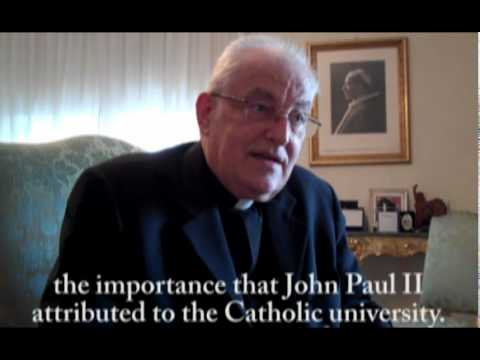
CORPUS CHRISTI, TX (Catholic Online) - As we wrote in a previous article, after decades-long and unsuccessful efforts by the Holy See to get the Pontifical Catholic University of Peru (PUCP) to abide by the canonical requirements established by Blessed John Paul II in his apostolic constitution Ex Corde Ecclesiae which are intended to assure that Catholic universities abide by their mission, the Vatican Secretary of State finally delivered a strong sanction: it ordered that the University remove the names "Pontifical" and "Catholic" from its name.
"The Holy See, with decree of His Eminence, the Secretary of State [Cardinal Tarcisio Bertone], under a specific pontifical mandate, has decided to remove from the Pontifical Catholic University of Peru the right to use in its name the titles 'Pontifical' and 'Catholic,' in accordance with canon law," the Vatican announced July 21, 2012.
Really, the decree of the Holy See is recognizing de jure what is already de facto obvious to any honest observer. Whatever this Peruvian university is under its Rector Marcial Rubio Correo, it is neither Pontifical nor Catholic. Indeed, it is anti-Pontifical and anti-Catholic. Yet in an interview after the Holy See's action, Rubio stubbornly maintained the university would retain the names since they are part of its legal trademarks or servicemarks. The Rector's intransigence will probably require future legal action by the Holy See.
According to Gonzalo Flores, an expert on canon and civil law and an advisor to the Peruvian bishops, the university refusal to abide by the decree of Cardinal Bertone is a losing battle. "The university has no escape, according to Peruvian legislation," Flores told the Catholic Register. "The concordat between Peru and the Vatican, which recognizes the autonomy of the Catholic Church to decide on all things Catholic, trumps any copyright [or servicemark] claim."
The problem with the Pontifical Catholic University of Peru actually pre-dates the 1990 apostolic constitution Ex Corde Ecclesiae. The apostolic constitution represents Blessed John Paul II's efforts to cure the problem of Catholic universities which had lost their sense of mission, or whose mission has become inconsonant with the mission of the Church.
There is a certain irony in the current situation. The Pontifical Catholic University of Peru was founded by the French priest, Fr. Jorge Dintilhac, a member of the Congregation of the Sacred Hearts of Jesus and Mary and of the Perpetual Adoration of the Most Holy Sacrament of the Altar in 1917. It was founded to be an authentic Catholic alternative to Universidad de San Marcos, a Dominican school founded in 1551 which had itself been captured by anti-Catholic intellectuals at the time. The university's pontifical status was granted by the Holy See in 1942.
Unfortunately, in the 1960s the PCUP itself was besieged by theologians that were influenced by liberation theology, a Marxist interpretation of the Gospel which is untrue to it, and in fact Father Gustavo Gutiérrez Muerino, one of liberation theology's most vociferous promoters, was named director of the School of Religious Studies in 1967, which later became the Department of Theology in 1969.
Gutiérrez is perhaps best known for what is considered the foundational text of this thinking published in 1971, A Theology of Liberation: History, Politics, and Salvation. In 1984, the Congregation for the Doctrine of the Faith, then-headed by Cardinal Prefect Joseph Ratzinger (now Pope Benedict XVI) was critical of some aspects of this manner of theology, and issued its Instruction on Certain Aspects of the "Theology of Liberation".
The Congregation's instruction largely fell on deaf ears. The university's School of Theology has never been able to overcome the virus of its original founding, and so suffers from the theological foibles of its original director. In fact, Gutiérrez's text is still considered required reading by theology students.
In 1976, the university adopted a new legal form that was calculated to reduce to a minimum the influence of the Church, to reduce the role of the Archbishop of Lima to a mere figurehead, and to minimize the Church's hiearchy's ability to govern day-to-day affairs of the university.
The efforts at securing independence from the Church hierarchy in the 1970s were resisted by Cardinal Archbishop Juan Landázuri, as well as his successor Cardinal Archbishop Augusto Vargas, but the Archbishops were not successful, and eventually, the Archdiocese was even denied the right to serve on the school's governing board.
By 1994, PCUP had "completely abandoned a Catholic identity," as Natale Amprimo, the attorney for the Archdiocese of Lima put it.
The dispute between the Church hierarchy and the independently-minded university came to a head with the efforts of the Cardinal Archbishop Juan Luis Cipriani to exercise his rights over the university and to implement the requirements of Ex Corde Ecclesiae.
The governing body of the university refused to allow Cardinal Cipriani his rights, and sued the Archdiocese to prevent him from asserting them, but in June of this year, Peru's Constitutional Court ruled that the archdiocese had the right to appoint a member to the university's board of directors, and that the university had exceeded its authority in ignoring that right.
The leaders of the university have been recalcitrant, even vituperative in their response to the Vatican's recent moves. The rhetoric used by Catholic officials is highly anti-Catholic and anti-clerical. Of course, the words "academic freedom" and "autonomy" are bandied about. But as anyone knows, the words "academic freedom" and "autonomy" are particularly vague terms, and so are ideal terms with which a whole host of intellectual sins and sins against faith can be covered.

The Cardinal Archbishop Cipriani, who, under the governing instruments of the university is supposed to exercise control over the assets of the university and is to have some power of appointment, is accused of being money-hungry and power-hungry. Perhaps saving their worst insult of all, Archbishop Cipriani is accused of being "arch-conservative," and a member of Opus Dei to boot (egads!).
For example, the vice-rector of the university, EfraĂn Gonzales de Olarte, accused Cardinal Archbishop Cipriani of officious intermeddling, though he is doing nothing but implementing the requirements of the legal instruments of the university and the requirements of Ex Corde Ecclesiae. Gonzales sees a sort of political conspiracy animated by the devious Opus Dei.
"Monsignor Cipriani," Gonzales noted, "is the most well-known cardinal of Opus Dei, and obviously everyone knows Opus Dei has a political agenda." Opus Dei, of course, denies having a political agenda. But in his feigned offense, Gonzales is a poseur, inasmuch as he wears his political motives, largely leftist, on his sleeves. Gonzales continued: "We think this is part of the plan they have. So of course the archbishop uses all of his influence to take control of this very good university."
The Cardinal Archbishop's efforts are hardly based upon political motives. As he put it in a recent radio interview on Radio Programas del Peru (RPP) where he addressed his motivations: "I would ask them in all humility, 'Do you identify with the Church? No? Then what are you doing in this university?'"
Natale Amprimo, Cipriani's lawyer, debunked the Opus Dei connection. "The idea that the cardinal (Cipriani) controls the Holy See's secretary of state, and controls the pope--they've created this whole fiction to try to justify what can't be justified," Amprimo told Reuters.
According to a report in the New York Times, the University President, Marcial Rubio cast the dispute as simply a power-play over who would control property. To a gathering of students, Rubio stated: "They've told us, 'Hand over your money and obey." He had no qualms in calling Fr.Luis Gaspar, a member of the ecclesiastical tribunal in Peru, a "terrorist against the university." In an interview to CNN en Español, Rubio stated that the "whole issue nothing more than an attempt of the Archdiocese of Lima to take control of the financial resources of the university."
But that is clearly not the dynamic motivating Rome. The university has consisted flouted Catholic values. For example, in 2002, it awarded an honorary degree to Gianni Vattimo, an Italian homosexual activist and postmodern nihilist philosopher, who, in his words "welcomes God's death." In 2012, it awarded an honorary degree to Gregorio Peces-Barba, a virulently anti-Catholic Spanish jurist and politician. It also publicly supported Father Gaston Garatea Yori, who was recently suspended from priestly ministry by the Cardinal Archbishop Cipriani for advancing positions regarding homosexual marriage and priestly celibacy contrary to the Catholic teaching and discipline, respectively. The university's sociology and political science departments are chronically pro-abortion and pro-same-sex "marriage." The university has clearly lost its sense of Catholic mission. It is wed to the spirit of the world, and no longer authentically pontifical or Catholic.

Seeking to preempt efforts at undermining the support of the Peruvian bishops, Cardinal Bertone, the Secretary of State for the Vatican, sent a letter to the president of the Peruvian Bishops' Conference, Archbishop Salvador Piñeiro, asking that the bishops not allow the conference "to be used as an instrument by the rector's office of the university."
In response, Archbishop Salvador Piñeiro issued a statement in late July expressing its support of the Vatican decree and demanding that the university drop the use of both "Pontifical" and "Catholic."
What the university officials apparently have not learned is that the badge of being a "Pontifical" university, and the honor of being a "Catholic" university, are not rights, but privileges. They are legal graces, as it were, that can be lost by a lack of fidelity to the Church.
-----
Andrew M. Greenwell is an attorney licensed to practice law in Texas, practicing in Corpus Christi, Texas. He is married with three children. He maintains a blog entirely devoted to the natural law called Lex Christianorum. You can contact Andrew at agreenwell@harris-greenwell.com.
---
'Help Give every Student and Teacher FREE resources for a world-class Moral Catholic Education'
Copyright 2021 - Distributed by Catholic Online

Come Grow With Us
Sign up and walk the Catholic journey with millions around the world.
Receive inspiring emails on saints, daily readings, and free faith-building resources—no cost, ever.
Sister Sara Has One Message for Every Catholic Family This June
- Easter / Lent
- 5 Lenten Prayers
- Ash Wednesday
- 7 Morning Prayers
- Mysteries of the Rosary
- Litany of the Bl. Virgin Mary
- Popular Saints
- Popular Prayers
- Female Saints
- Saint Feast Days by Month
- Stations of the Cross
- St. Francis of Assisi
- St. Michael the Archangel
- The Apostles' Creed
- Unfailing Prayer to St. Anthony
- Pray the Rosary








Copyright 2026 Catholic Online. All materials contained on this site, whether written, audible or visual are the exclusive property of Catholic Online and are protected under U.S. and International copyright laws, © Copyright 2026 Catholic Online. Any unauthorized use, without prior written consent of Catholic Online is strictly forbidden and prohibited.
Catholic Online is a Project of Your Catholic Voice Foundation, a Not-for-Profit Corporation. Your Catholic Voice Foundation has been granted a recognition of tax exemption under Section 501(c)(3) of the Internal Revenue Code. Federal Tax Identification Number: 81-0596847. Your gift is tax-deductible as allowed by law.
